A streaming page may describe a Korean drama as a new season, a second part, a special episode, or a spin-off. Those labels can sound interchangeable, but they usually describe different relationships to the original story. Understanding the difference helps you find the correct viewing order, avoid accidental spoilers, and decide whether you need to watch an earlier series first.
The quick answer
A season normally continues or renews the main series. A part is usually one section of the same season or production. A special is an extra standalone installment, while a spin-off builds a separate story around a supporting character, setting, or idea. These are useful patterns rather than universal rules, so the official broadcaster or licensed streaming page should be your final reference.
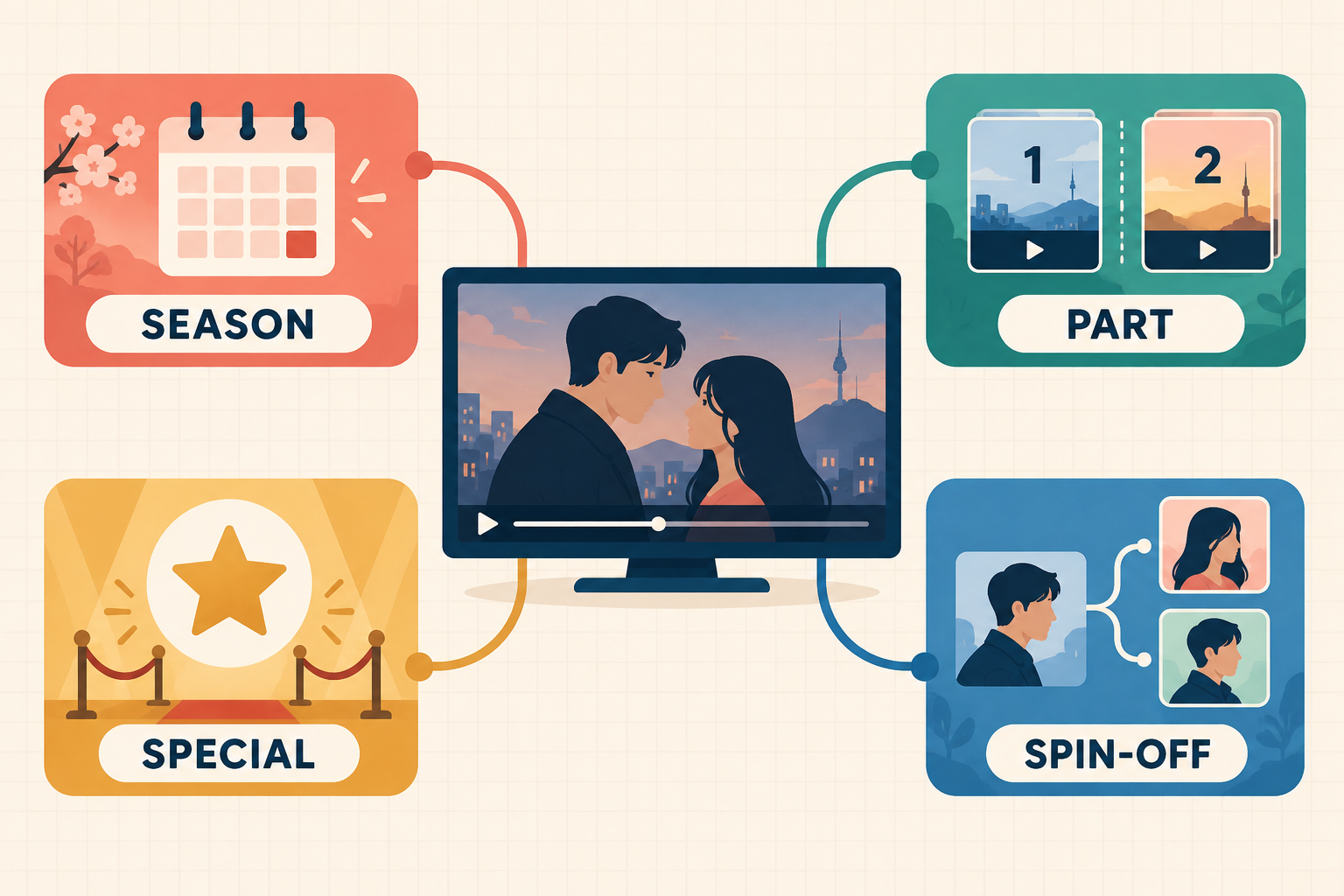
| Label | Usual meaning | Do you need the original? |
|---|---|---|
| Season | A continuation or a new chapter of the main series | Usually yes |
| Part | A divided release within one season or production | Watch the earlier part first |
| Special | An extra episode, recap, epilogue, or event program | Often helpful, but it depends on the format |
| Spin-off | A separate story using a character, world, or concept from the original | Recommended, though some spin-offs work alone |
What “season” usually means
A new season normally returns to the central story, cast, or fictional world. It may continue directly after the previous finale, begin after a time jump, or introduce a mostly new case while keeping the same main characters. If a platform clearly labels a title “Season 2,” the safest assumption is that Season 1 provides important context.
However, Korean television has a long tradition of complete single-season stories, so a second season is not automatic. Some successful dramas receive continuations, while others end exactly where the writers intended. An announcement, placeholder page, or fan rumor is not the same as an officially confirmed renewal.
What “part” usually means
A part is commonly a release division rather than a completely new season. A platform might publish Part 1 first and hold Part 2 for a later date. The production can still belong to one season, use one continuous episode count, and follow the same central conflict.
- Part 1 and Part 2: two batches of the same story.
- Cour or batch: another way a service may group episodes.
- Volume: sometimes used for a smaller group of episodes or physical releases.
- Chapter: a marketing label that may or may not match a formal season.
When a drama is split into parts, do not assume the first batch has a complete ending. Check the episode numbers and the announced return date. Our guide to K-drama episode counts and release schedules explains how weekly, full-season, and split releases affect the actual viewing timeline.
What a special episode can be
“Special” is the broadest label. It can describe a scripted epilogue, a holiday story, a recap, a behind-the-scenes program, an interview event, or a cast reunion. Some specials add meaningful story information; others are promotional or celebratory extras.
- Story special: new scripted material set before, during, or after the main drama.
- Epilogue: a short look at what happened after the finale.
- Recap: previously aired scenes edited into a summary.
- Behind the scenes: production footage, interviews, or commentary.
- Reunion or variety special: the cast appears as themselves rather than as the characters.
Read the description before assuming that a special is an additional drama episode. A recap can safely be skipped by many viewers, while a scripted epilogue may answer questions left open by the finale.
What makes a spin-off different
A spin-off moves attention away from the original main story. It may follow a supporting character, explore another workplace or family, use the same fictional universe, or expand a popular side plot. The tone and genre can change even when the new title shares actors or locations with the original.
A spin-off can be accessible to new viewers, but it often contains references that are more rewarding after the original. Check whether the official description calls it a sequel, prequel, side story, or standalone title. Those words provide better clues than cast overlap alone.
Sequel, prequel, remake, and adaptation are not the same thing
- Sequel: continues after the original story.
- Prequel: takes place before the original story.
- Remake: retells an earlier drama, film, or series in a new production.
- Adaptation: transforms a story from another medium, such as a webtoon or novel.
An adaptation is not automatically a spin-off. It may tell the same central story in a different medium while changing pacing, characters, or plot structure. If you are comparing versions, see our guide to what changes when a webtoon becomes a K-drama.
Why platforms sometimes use different labels
International services do not always organize the same program in identical ways. One service may show two parts under a single season, while another creates separate season pages. Episode numbering can also change when long broadcast installments are divided into shorter files. Regional licensing may make a special available in one country but not another.
For that reason, compare more than the English title. Look at the Korean title, cast, release year, episode numbers, official artwork, and synopsis. If the pages still appear inconsistent, use the broadcaster’s program page or the licensed service available in your country.
A safe viewing-order checklist
- Confirm the exact title. Translated titles can differ between regions.
- Check the label and release year. A title with the same name may be a remake rather than a continuation.
- Compare episode numbering. Part 2 may begin with the next episode number instead of Episode 1.
- Read a spoiler-free official synopsis. It often states whether the story follows earlier events.
- Check regional availability. Your country may list the series differently or omit a special.
- Watch extras after the relevant episode. Behind-the-scenes clips and recaps can reveal later scenes.
If you cannot find one of the titles in your region, use our guide on how to find where a K-drama is legally streaming in your country before paying for another service.
Frequently asked questions
Is Part 2 always the same as Season 2?
No. Part 2 often continues the same season or production, while Season 2 is presented as a new chapter. Platforms can label releases differently, so confirm the episode numbering and official description.
Can I watch a spin-off first?
Sometimes, especially when the spin-off introduces its own cast and conflict. But the original usually adds context and may prevent confusion about relationships, recurring jokes, or the fictional world.
Does a special count as an official episode?
Not always. A scripted special may function like an extra episode, while a recap or cast program is separate from the drama’s numbered story. Check how the broadcaster classifies it.
Before choosing a split-season or weekly title for your next binge, use our spoiler-free checklist on how to tell if a K-drama is fully released.
Final takeaway
Use the label as a starting point, then verify the episode numbers, release year, official synopsis, and regional listing. In most cases, seasons continue the main series, parts divide one release, specials add optional or extra material, and spin-offs tell a related story from a new angle.
Streaming labels and regional availability can change. Always confirm the latest viewing order on the official broadcaster or licensed platform page for your country.
Leave a Reply