Author: Moapad Culture

  • How K-Drama Episode Counts and Release Schedules Work

    How K-Drama Episode Counts and Release Schedules Work

    A K-drama may have 8, 12, 16, 20, or more episodes, but the number alone does not tell you how long the series will take to finish. Release frequency, episode length, regional licensing, subtitles, and occasional schedule changes all affect when you can actually watch a new episode. This guide explains the patterns without assuming that every drama follows the same timetable.

    The quick answer

    Many modern Korean dramas are built as a single season with a planned ending. A 16-episode drama released twice a week usually runs for about eight weeks. A 12-episode drama released twice a week usually runs for about six weeks. Streaming-first series may use shorter seasons or release several episodes at once. Daily and weekend family dramas can be much longer.

    Treat those numbers as useful patterns, not rules. The official broadcaster or streaming-service title page should always be your final source for the current episode count and release calendar.

    Why episode counts differ

    K-dramas are produced for several different release models. A prime-time television drama is often organized around a fixed weekly broadcast slot. A streaming original may be designed for a shorter, faster season. A family drama can run for months, while a special series may tell its story in only a few episodes.

    • 8 episodes: often a compact streaming series, genre experiment, or tightly focused story.
    • 10–12 episodes: common for shorter contemporary dramas and some streaming originals.
    • 16 episodes: a familiar structure for romance, workplace, fantasy, and mystery dramas.
    • 20 or more episodes: more common in historical epics, family stories, and productions with broader casts.
    • Daily or weekend series: these may have dozens of episodes and use a different production rhythm.

    Episode length also matters. One service may present a broadcast installment as a single 60-to-80-minute episode, while another listing may divide similar material into shorter parts. That is why two databases can appear to disagree even when they cover the same story.

    The most common release patterns
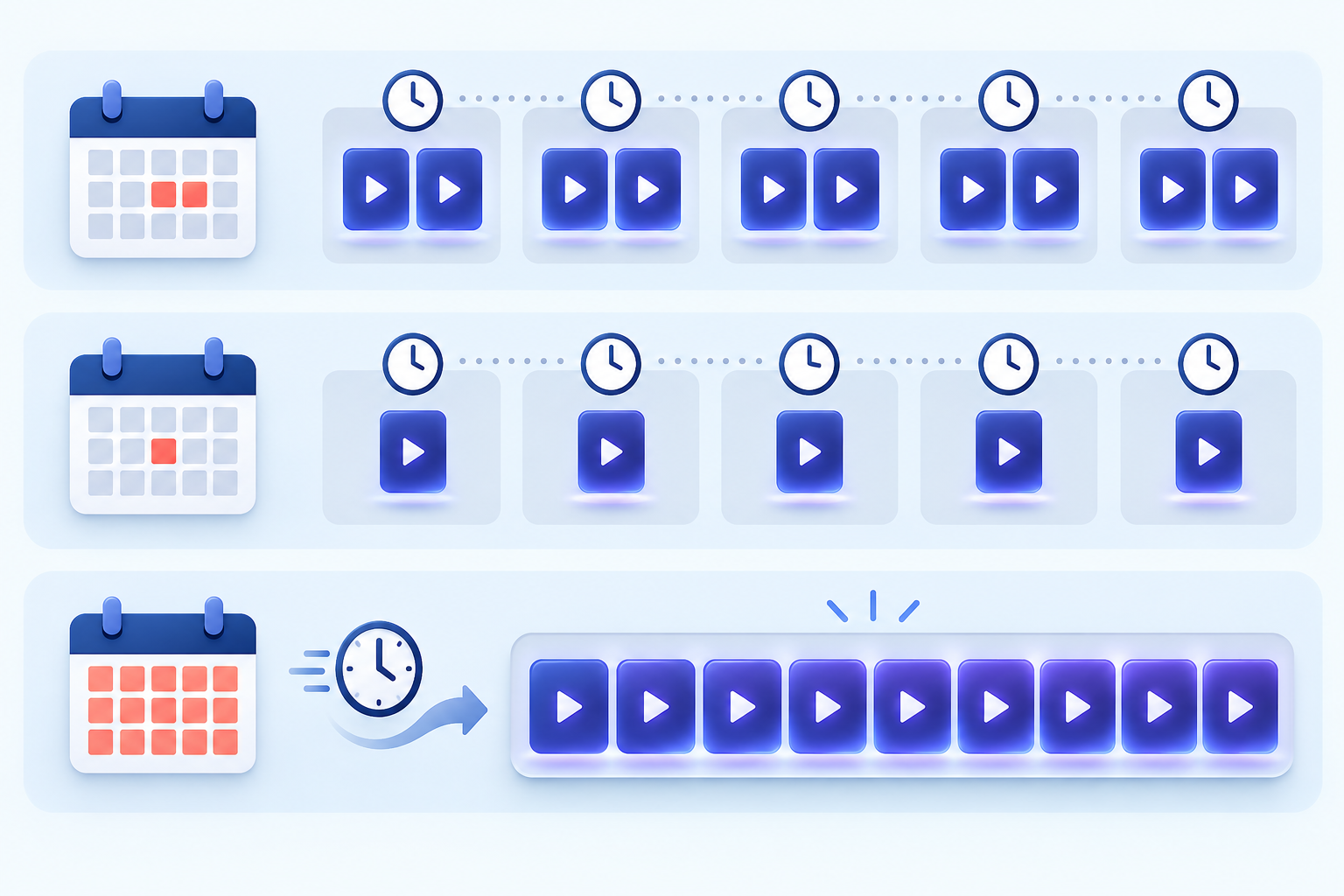
    Visual comparison of twice-weekly, weekly, and full-season K-drama release patterns
    Release patternWhat it usually meansWhat to check
    Two episodes per weekOften consecutive days, such as a weekend or midweek pairLocal broadcast time and your region’s upload time
    One episode per weekA longer viewing window between installmentsWhether the platform labels the date in your time zone
    Full-season releaseAll episodes become available togetherWhether every episode has your preferred subtitle or audio track
    Split releaseA season arrives in two or more batchesThe announced date for the next part
    Daily or weekend broadcastMore episodes and a longer overall runHoliday interruptions and regional licensing

    Broadcast time is not always streaming time

    The Korean broadcast time and the international streaming time are not necessarily identical. A platform may upload the episode after the television broadcast ends, after subtitles are ready, or at a fixed global release time. The delay can vary by country and by title.

    Before waiting for a specific hour, confirm that you are looking at the listing for your own country. Our guide on how to find where a K-drama is streaming in your country explains how to verify the correct title, legal service, and regional availability.

    Why a new episode can appear late

    • Subtitle production: translation, timing, and quality review take time.
    • Regional rights: the same title may have different release arrangements in different markets.
    • Broadcast changes: special programming, live sports, holidays, or production issues can move an episode.
    • Platform processing: video, captions, age ratings, and metadata may not update simultaneously.
    • Time-zone confusion: a Korean date may become the previous or next calendar date where you live.

    A missing episode does not automatically mean that your subscription is broken. Check the platform’s episode list, official social account, or help page before changing plans or paying for another service.

    Subtitles and dubbing may follow different schedules

    English subtitles may appear with the episode, shortly afterward, or on a different schedule in some regions. Dubbing generally requires additional production and may be released later or only for selected titles. Closed captions and subtitles are not always the same track.

    If language options are important to you, use our K-drama subtitles vs. dubbing guide to compare original audio, translated subtitles, SDH/CC, and dubbed tracks before you commit to a series.

    A five-step release schedule check

    1. Confirm the exact title. English titles can differ across services, so compare the Korean title, cast, and artwork. If the platform names do not match, use our guide to identifying the right K-drama when English titles differ.
    2. Check the total episode count. Use the official title page rather than an old preview article.
    3. Identify the release model. Look for weekly, twice-weekly, full-season, or split-part language.
    4. Set the correct region and time zone. Make sure the service is showing availability for your location.
    5. Verify the language track. An episode may be online before your preferred subtitles or dub is ready.

    Should you watch weekly or wait to binge?

    Weekly viewing reduces the risk of accidental spoilers only if you can keep up with the schedule, and it can make discussion with other viewers more enjoyable. Waiting to binge gives you control over pacing and helps avoid uncertainty caused by schedule changes. Neither method is better for everyone.

    If you decide to wait, note the expected finale date but check it again near the end of the run. A planned schedule can change. Also remember that a “finale” may refer to the end of one part rather than the complete story when a series uses a split release.

    If a listing uses “Season 2,” “Part 2,” “special,” or “spin-off,” our guide to K-drama seasons, parts, specials, and spin-offs explains what each label usually means and the safest viewing order.

    Frequently asked questions

    Are all K-dramas 16 episodes?

    No. Sixteen episodes is a recognizable format, but shorter 8-to-12-episode seasons, longer historical dramas, daily series, and split streaming releases are all common enough that you should verify each title.

    Why does a platform show a different episode count?

    The service may divide long broadcast installments into shorter parts, combine parts, count specials, or display only the episodes currently licensed in your region.

    Can a release date change after it is announced?

    Yes. Broadcast programming, production circumstances, holidays, and platform decisions can change the schedule. Recheck the official title page close to release day.

    When you want to know whether every planned episode and subtitle is ready now, follow our spoiler-free guide on how to tell if a K-drama is fully released.

    Final checklist

    Before starting a K-drama, record four things: the total episode count, release days, your local upload time, and available language tracks. That small check prevents most confusion and helps you decide whether to follow the series weekly or wait for the finale.

    Availability and schedules can change. Always verify the latest information on the official broadcaster or licensed streaming service for your country.
  • How to Find Where a K-Drama Is Streaming in Your Country

    How to Find Where a K-Drama Is Streaming in Your Country

    Source check: September 16, 2026

    Short answer: search the exact drama title on official streaming services while your account is set to your real country and preferred language. Then verify the title page, subscription or rental requirement, subtitle options, and date checked. A recommendation from another country—or an old search result—does not prove that the show is available to you today.

    This guide gives you a repeatable way to locate a legal stream without promising that one service has the same catalogue everywhere. It does not recommend VPNs, copied uploads, or sites that do not identify their licensing source.

    Why the same K-drama appears in one country but not another

    Streaming rights are usually licensed by territory. Netflix explains that a show can be available in one country but missing in another because rights may belong to different studios or distributors, may not be offered for sale in that territory, or may be exclusive to another platform. Netflix also says its library varies by country and changes periodically.

    Viki gives a similar explanation: a “not available in your region” message means it does not hold the licence for that geographic location. Paying for Viki Pass does not remove the regional restriction. KOCOWA likewise publishes a country list for its service rather than claiming worldwide availability.

    That means three separate questions must be answered:

    Question What proves it
    Does the service operate in my country? The service’s current official country or availability page.
    Is this exact drama licensed here? A playable title page shown for your actual region and account.
    Can I watch it in a useful language? The title’s current audio and subtitle menu—not a general claim about the platform.

    A seven-step method that works across platforms

    1. Record the exact title and identifying details

    Write down the official English title, Korean title if available, release year, broadcaster, and one or two lead actors. Localized titles can differ, and unrelated shows can share similar English words. These details prevent you from mistaking a remake, film, variety program, or recap for the drama you want.

    When two services use different English names, follow our guide to identifying the right K-drama when English titles differ before comparing regional availability.

    If the listing says “Season 2,” “Part 2,” “special,” or “spin-off,” use our guide to K-drama seasons, parts, specials, and spin-offs to confirm whether it continues the same story or is a separate title before checking platforms.

    If the drama was adapted from a comic, source credits can help confirm identity. Our guide to finding the original webtoon behind a K-drama without spoilers shows how to cross-check official titles and creator names without opening plot-heavy fan pages.

    2. Start with the official broadcaster or distributor

    Search the broadcaster, production company, or international distributor before using a general web search. Its programme page may name the licensed streaming partner or provide an official title that works better in platform search.

    A press release can establish that a service acquired a title, but it may describe only certain territories or a release window. Read the geographic wording and publication date. “Streaming on Netflix” is not automatically the same as “available on Netflix in every country indefinitely.”

    3. Search inside each official service

    Use the service’s own website or app while signed in to the profile you actually use. Search the exact title, then try the Korean title, creator, or lead actor if the first search fails.

    Netflix notes that a missing title can also be hidden by a profile’s maturity rating, blocked-title setting, profile language, or a VPN connection. Therefore, an empty result does not always prove that nobody in your country can see the show. Check the profile and connection before drawing that conclusion.

    Viki’s official search guide says its app filters can include region, format, genre, subtitle language, and schedule. Filters are useful for discovery, but the individual channel page is still the place to verify the exact episodes and viewing conditions.

    4. Confirm access on the title page

    Do not stop when a poster appears in search. Open the title page and check whether an episode can actually be played. Look for labels such as subscription required, rental, free with ads, coming soon, or unavailable in your region.

    On Viki, a subscription icon may identify Viki Pass content, but the platform explicitly says that regional restrictions still apply to its plans. Subscription availability and title availability are different facts. The same principle applies elsewhere: a service account does not guarantee access to every item in its catalogue.

    5. Check audio and subtitles before paying

    A legal stream is not useful if it lacks a language option you can comfortably follow. Open the audio and subtitle menu for the actual title. Do not assume that every episode or device offers the same languages.

    If several English tracks appear, they may serve different purposes. Our practical guide to K-drama subtitles, English dubbing, and SDH/CC explains why translated subtitles and captions designed for a dub may use different wording.

    Before purchasing access, follow our step-by-step checklist for checking English subtitles and dubbed audio before you subscribe. It covers regional catalogues, profile settings, devices, and episode-by-episode differences.

    6. Write down the country and date checked

    A useful recommendation should say more than “I found it.” Record the country or territory, service, access type, available language, and date. For example:

    • Title: exact series name and release year
    • Country checked: your real current location
    • Service: official platform name
    • Access: included, ad-supported, subscription, rental, or purchase
    • Language: audio and subtitle options you verified
    • Checked: September 16, 2026

    This does not guarantee future availability. It makes the result honest and useful to someone checking under similar conditions.

    7. Recheck before subscribing or renting

    Catalogue pages, licensing windows, plan benefits, and prices can change. If you found a recommendation several weeks ago, repeat the title-page check immediately before paying. Confirm whether the full series is present, whether the newest episodes have arrived, and whether your preferred subtitle track is available.

    If you plan to watch on a TV, check that the streaming app works on your exact model before paying for a plan. Our TV app compatibility checklist explains how to verify the app store, supported device, title access, and playback options separately.

    What to do when search results disagree

    You may see a search engine card saying that a drama is on a particular service while the service itself shows nothing. Give more weight to the current official title page for your region than to an undated snippet or third-party list.

    • Check whether the search result refers to another country.
    • Confirm that the title and release year match.
    • Look for “coming soon,” “leaving soon,” or expired licensing language.
    • Try the platform’s official app and current supported browser.
    • Check profile language and maturity settings.
    • Disable a VPN or proxy and search again from your normal connection.

    If the service says the show is unavailable in your region, do not treat a subscription upgrade as a workaround unless the official page explicitly says the plan changes access. Viki states that Viki Pass does not override regional licensing, and Netflix lists territorial rights as a reason titles differ.

    How to evaluate an unfamiliar streaming site

    A site displaying a video player is not proof of authorization. Before creating an account or entering payment details, look for the company name, terms of service, privacy policy, support contact, supported countries, and an identifiable relationship with broadcasters or rights holders.

    Warning signs include complete seasons offered without a distributor name, copied subtitles with no licence information, aggressive download prompts, and claims of every show being free worldwide. Avoid browser extensions or software that a questionable site says are required to play a stream.

    Our broader webtoon-versus-K-drama guide uses the same evidence principle: separate what an official source confirms from what a fan comparison assumes.

    A five-minute availability checklist

    1. Confirm the official English or Korean title and release year.
    2. Check the broadcaster or distributor for an international platform reference.
    3. Search the title inside official services available in your country.
    4. Open the title page and verify that an episode is playable.
    5. Check access type, audio, subtitles, episode range, country, and date.

    If no official service currently carries the title in your region, the accurate answer is “not confirmed as legally available here today.” Save the identifying details and check again later rather than replacing uncertainty with an unlicensed upload.

    After finding the correct regional listing, use our spoiler-free checklist on how to tell if a K-drama is fully released before planning a full-season binge.

    If you also need offline viewing for travel or commuting, do not assume that streaming access includes downloads. Use our K-drama download-availability checklist to verify the exact plan, device, episode, language tracks, storage, and expiration rules before paying.

    Bottom line

    To find where a K-drama is streaming, verify the exact work on official title pages under your real regional conditions. Country availability, title licensing, plan access, and language support are separate checks. Recording the date and region turns a vague recommendation into evidence that another viewer can understand.

    Official references

    This article was prepared with AI-assisted research and editorial review. Streaming catalogues, prices, plan benefits, interfaces, and regional rights can change. Confirm the current information on the official service before subscribing, renting, or purchasing. Read our content principles, or send corrections through Contact & Corrections.

  • K-Drama Subtitles vs. Dubbing: A Practical Viewing Guide

    K-Drama Subtitles vs. Dubbing: A Practical Viewing Guide

    Source check: September 14, 2026

    Should you watch a K-drama with the original Korean audio and English subtitles, or switch to an English dub? There is no single correct answer. The better choice depends on what you want to notice, how quickly you read, the device you are using, and whether accessibility features help you follow the story.

    This guide explains the practical differences without treating one format as automatically superior. It also shows why the English words on screen may not exactly match the English dialogue you hear.

    Quick answer

    • Choose Korean audio with English subtitles when you want to hear the actors’ original voices, speech rhythm, and emotional delivery.
    • Choose an English dub when reading pulls your eyes away from acting, action, costumes, or visual clues.
    • Choose English SDH or closed captions when you also need speaker labels, music descriptions, or sound cues. Availability and naming vary by service and title.
    • Try both for the same short scene if you are unsure. The version that lets you understand the story with less effort is usually the right one for that show.

    What actually changes between the options?

    Option What you keep Possible trade-off Best fit
    Original Korean audio + English subtitles Original voices, pauses, tone, and vocal performance Your eyes may spend more time reading Viewers who value performance nuance and read comfortably
    English dub More visual attention and easier hands-off viewing Voice casting, timing, and phrasing differ from the original performance Viewers who prefer listening or need to focus on the screen
    English SDH/CC Dialogue plus useful non-dialogue information The text may follow the dub rather than another subtitle track Viewers who benefit from sound cues, speaker labels, or dialogue transcription

    Why subtitles and dubbed dialogue may not match

    A mismatch does not automatically mean that one version is wrong. Subtitles and dubbing solve different timing problems.

    Subtitles must remain readable while a scene keeps moving. Netflix’s timed-text guidance says subtitles should synchronize with picture and audio and should not reveal punchlines or plot points too early. Long sentences may therefore be shortened or divided so viewers can read them naturally.

    Dubbing has a different constraint: translated dialogue must fit the available speaking time and work with the character’s visible delivery. The result may express the same idea with different wording.

    English SDH can create another surprise. Netflix’s English timed-text guide says that when a title is dubbed into English, English SDH should match the dubbed audio as closely as reading speed and timing allow. That is why an “English” subtitle track and an “English (CC)” or “English SDH” track can show different sentences during the same Korean scene.

    Subtitles are best when the original performance matters most

    Original audio preserves the actor’s own voice, breath, hesitation, volume, and rhythm. Those details can be especially important in scenes built around hierarchy, politeness, embarrassment, or restrained emotion.

    Still, subtitles cannot carry every layer of spoken Korean. Honorifics, relationship terms, jokes, and culturally familiar expressions sometimes need to be condensed or adapted. Treat the subtitle as a carefully timed viewing aid, not a word-for-word transcript.

    If you are comparing how a story feels in different forms, this is similar to the changes that happen between a comic and a screen adaptation. Our guide to what changes from webtoon to K-drama explains why performance, pacing, and structure can alter the experience even when the main story remains recognizable.

    Dubbing is best when reading competes with the picture

    K-dramas often communicate through small visual details: a character’s reaction after another person turns away, a message visible for only a moment, food placed on a table, or a change in posture during a tense conversation. If reading makes you miss those details, dubbing can improve your overall understanding.

    Dubbed audio can also be the more comfortable option for viewers with reading fatigue, some visual impairments, or attention needs. It may help when watching on a small screen, although important episodes deserve full attention rather than background listening.

    A dub is not automatically less faithful. It is a separate adaptation that balances meaning, timing, performance, and natural English. Judge it by whether the scene remains clear and emotionally convincing—not by whether every line matches another subtitle track.

    How to tell subtitles, captions, and SDH apart

    Labels differ among streaming services, but these distinctions are useful:

    • English subtitles generally translate non-English dialogue for viewers who can hear the rest of the soundtrack.
    • English SDH means subtitles for deaf and hard-of-hearing viewers. It may include speaker identification, music information, and relevant sound effects.
    • Closed captions (CC) are captions the viewer can turn on or off. Some services use “CC” more broadly, so check what the selected track actually contains.

    If a caption track seems different from the translated subtitle track, switch between the available English options during the same scene. One may be based on the original Korean dialogue, while another may be designed to accompany the English dub.

    A five-minute test before choosing

    1. Select a spoiler-free scene near the beginning with both conversation and visible action.
    2. Watch two or three minutes with Korean audio and English subtitles.
    3. Replay the same section with the English dub. If available, test the regular English subtitle and English SDH/CC tracks separately.
    4. Ask which version helped you notice facial expressions, relationships, and story information with less effort.
    5. Keep that setting for the episode. Change later if the dialogue becomes faster or the visual storytelling becomes denser.

    This test is more useful than arguing about a universal winner. A historical drama with unfamiliar titles may feel easier in one format, while a visually dense thriller may work better in another.

    When a language option is missing

    Netflix explains that available audio and subtitle languages can depend on your location, profile language preferences, the title, the device, and licensing agreements. Downloads may show only the two most relevant languages, and some older devices do not support every subtitle language.

    Before assuming that a translation does not exist, try these checks:

    • Open the title’s Audio & Subtitles menu while streaming rather than viewing a download.
    • Check the language preferences for the active profile.
    • Try a supported, updated device or web browser.
    • Remember that a weekly series may add language options after an episode or season is completed.

    Before paying for a service, verify the exact episode in its player. Our checklist explains how to check a K-drama’s English subtitles and dubbed audio before you subscribe, including regional, profile, device, and episode-level differences.

    What if the drama came from a webtoon?

    Translation is only one source of difference. A drama may combine characters, rearrange events, or create a new ending before any subtitle or dub is produced. If you want to trace the source without exposing yourself to major plot details, use our step-by-step guide to finding the original webtoon behind a K-drama without spoilers.

    Bottom line

    Use subtitles when hearing the original performance is your priority. Use dubbing when reading competes with the visual story or when listening is more accessible. Use SDH or captions when sound information and speaker identification improve comprehension. Switching formats is not cheating; it is a viewing choice.

    The most reliable test is simple: compare the same short scene, then choose the version that helps you follow both the story and the screen.

    Official references

    This article was prepared with AI-assisted research and editorial review. Platform interfaces and language availability can change. We verify operational details against the linked official sources. For our editorial approach, see Content Principles. Questions or corrections may be sent through our Contact page.

  • How to Find the Original Webtoon Behind a K-Drama Without Spoilers

    How to Find the Original Webtoon Behind a K-Drama Without Spoilers

    Short answer: begin with the drama’s official page or production material, record the credited source title and creator names, and then match those details on an authorized comics platform. A title match by itself is not enough because translations, punctuation and localized titles can differ.

    This guide gives you a repeatable, spoiler-conscious method. It does not assume that every K-drama has a webtoon source, and it does not treat fan wikis, repost sites or search snippets as proof.

    Why the title alone can mislead you

    A drama may use an English title that differs from the comic’s translated title. The same words may also belong to unrelated works. Even when a title is shared, a search result can point to a recap, an unofficial upload or a different-language edition rather than the original comic.

    Use several identifiers together: the adaptation statement, the credited writer or artist, the original publisher or platform, and the work’s official description. This takes a few extra minutes, but it is more reliable than clicking the first result.

    A seven-step source-checking method

    1. Confirm that the drama is an adaptation

    Start with the broadcaster, streaming service or production company. Look for wording such as “based on,” “adapted from,” or “original story.” Record the exact source title, creator names and publisher when they are provided. Do not infer an adaptation merely because a drama resembles a comic genre.

    2. Search by creator as well as title

    Search the authorized platform using the credited creator’s name and the title. If an English title is not obvious, keep the official drama credit open while checking the comic listing. Matching both the title and creator is stronger evidence than matching either one alone.

    3. Check the listing page, not only a search card

    Open the series page and confirm the creator names, genre, synopsis and any adaptation note. A search-engine snippet can be shortened, stale or taken out of context. The publisher’s own listing is the better place to check the current edition.

    4. Separate identity from access

    Finding the correct comic does not mean every chapter is available in your browser, language or country. Check the platform’s current app and web options, content rating, preview rules and payment terms. Our guide to official English webtoon sources and access rules explains what to verify before you begin reading.

    5. Avoid spoilers while verifying

    Use official series pages and production credits before browsing fan-maintained character pages, episode recaps or comparison videos. Search suggestions and thumbnails can reveal major events. If you only want to identify the source, stop once the title, creators and authorized edition agree.

    6. Note the date and region you checked

    Licensing and catalogue availability can change. Write down when and where you checked the listing rather than promising that the same access will exist everywhere or indefinitely. A dated note is especially useful if you share the result with another reader.

    7. Compare only after you choose your viewing order

    Identifying the source is different from judging the adaptation. If you want to compare pacing, performance, characters and structure after finding the original, use our spoiler-free guide to what changes when a webtoon becomes a K-drama.

    Worked example: Sweet Home

    Netflix’s official Sweet Home Season 2 guide states that the series is based on the webtoon of the same name by Carnby Kim and Youngchan Hwang. The official English WEBTOON listing for Sweet Home names Carnby Kim and Youngchan Hwang.

    That gives us two aligned facts from the rights-holder or distributor side and the comics-platform side: the shared title and the same credited creators. We do not need a fan summary to establish the relationship, and we do not need to read plot descriptions that might disclose later events.

    Worked example: All of Us Are Dead

    Netflix’s official creator feature identifies All of Us Are Dead as an adaptation of Joo Dong-geun’s webtoon. The official English WEBTOON series page identifies Joo Dong-geun as the creator and displays a mature-content rating.

    The creator match confirms the source relationship. The rating is a separate access consideration: it helps a reader decide whether to proceed, but it is not evidence that the drama and comic are identical.

    Evidence checklist

    CheckStrong signalWeak signal
    Adaptation statusOfficial “based on” or “adapted from” creditA fan post says the stories are similar
    IdentityTitle plus matching creator namesTitle alone
    Reading sourcePublisher or licensed platform listingReposted chapters with no rights information
    AvailabilityCurrent listing checked for your language and regionAn old undated recommendation

    A five-minute worksheet

    • Drama: official English title and distributor
    • Source credit: exact wording used by the official drama page
    • Creators: writer and artist names as credited
    • Comic listing: authorized platform and language edition
    • Access: web or app, rating, preview and unlock conditions
    • Checked: date and country or region

    If one field does not match, pause and recheck. A difference can be harmless transliteration or localization, but it can also mean you found another work. When evidence remains ambiguous, say that it is unconfirmed rather than filling the gap with a guess.

    Red flags to avoid

    • A site offers complete chapters but does not identify a publisher or license.
    • A post calls a drama “webtoon-based” without linking to an official credit.
    • The title matches, but the creator names do not.
    • A search result promises free worldwide access without current terms.
    • A comparison article reveals endings before it establishes the source.

    What to do next

    Once you confirm the original, decide whether you want to read first, watch first or compare later. Use the authorized edition available to you, and keep source identification separate from opinions about which version is better. That small distinction makes recommendations clearer and reduces the chance of sending readers to the wrong work.

    After choosing your viewing order, use our practical guide to compare Korean audio with English subtitles, an English dub, and English SDH/CC without assuming that one option is always best.

    Source check: September 14, 2026. This is an AI-assisted, source-based guide with editorial checking. It is not a claim of firsthand viewing or reading of every title mentioned. Availability and platform terms may change; use the linked official pages for current information.

    Read our content principles, or send a correction with the relevant source through Contact & Corrections.

  • Where to Read Webtoons in English: Official Sources and Access Rules

    Where to Read Webtoons in English: Official Sources and Access Rules

    Start with the title, not the promise of “free.” Find the creator or publisher’s official link, confirm that you have the English comic edition, and check how the next locked episode can be opened. A free preview, a timed unlock and an episode purchased with platform currency are different kinds of access.

    This guide uses WEBTOON and Tapas as practical examples, not as a complete list of publishers or a ranking. It will help you check a series before installing an app, waiting on a timer or spending money.

    1. Find the authorized English edition

    Begin with the creator’s verified website, the original publisher’s announcement or the adaptation’s official credits. Look for a link to the English edition and compare the credited writer and artist. If the English title differs, the creator credits can help you connect the two editions.

    Check the format as well: a comic adaptation and the prose novel it is based on may share a title. A result that says “novel” is not necessarily the illustrated series you meant to find. Read the description and sample rather than relying on cover art alone.

    Search results and reader recommendations can point you toward a title, but they do not establish that a particular upload is authorized. If you cannot trace an edition back to a publisher or creator, keep looking rather than entering payment details or downloading an unfamiliar reader.

    2. Separate the three questions behind “Is it free?”

    QuestionWhat to check
    Can I start reading?Whether the opening episodes are available as a preview.
    Can I continue without paying?Which specific episodes qualify for a waiting or other free-access option.
    Can I reread later?Whether an unlock expires, depends on availability, or is linked to your account.

    These questions prevent a common misunderstanding: being able to open chapter one does not tell you the cost or conditions of reaching the latest chapter. Before starting a long series, inspect at least one locked episode and the series information page. You do not need to confirm a purchase to read the available options.

    3. WEBTOON: check the Fast Pass icon and release details

    According to WEBTOON’s Fast Pass help page, Fast Pass offers early access to recent episodes on certain series. Episodes bearing that icon can be unlocked with Coins purchased inside the app. The current help text says some Fast Pass episodes become free after a period of time—not that every locked episode on the service will become free.

    For a series you are considering, open its current episode list and read the label on the episode you want. If a release countdown is shown, decide whether you prefer to wait. If the label or access option is different, read the explanation attached to that option instead of assuming Fast Pass rules apply.

    Do not turn a remembered Coin price from a different title into a budget for this one. Use the amount displayed for the actual episode and the current purchase screen. This guide does not quote a universal episode price or promise that purchasing access gives you a downloadable copy.

    4. Tapas: distinguish Ink, timed access and quick unlocking

    Tapas’s episode-unlocking guide describes premium episodes marked with a lock and options including Ink or eligible free-access methods. Its Wait Until Free option is available in the app for qualifying episodes; the eligible range and waiting period vary by series. The help page states that WUF-unlocked episodes are readable for 72 hours from unlock. Check the current series details before relying on a timer or access window.

    Tapas also explains that a bulk purchase includes episodes released at the time of purchase, not future episodes that have yet to appear. That matters if a series is ongoing: unlocking everything currently available is not the same as buying all future updates.

    A separate feature, 1-Tap, allows quicker episode purchases after you enable it for a series. If you want to approve each spend deliberately, check whether it is enabled before continuing to the next episode. The official help page explains how to switch it off from the series or episode controls.

    5. Choose a reading plan before choosing a currency pack

    Use this simple note before a purchase: title, language, episodes wanted, displayed unlock cost, access conditions, and spending limit. It makes the decision about the story you want to read, rather than about using up a discounted currency balance.

    For example, suppose you want to sample a story this weekend but do not yet know whether you like its pacing. Read the available preview first. If you enjoy it, inspect the next episode’s options. Waiting may suit an occasional reader; paying for a clearly identified episode may suit someone who wants to continue immediately. Neither choice requires committing to the whole series.

    If you mainly read in short sessions, consider whether a temporary unlock will stay available long enough for you to finish it. If you like rereading, check the relevant retention and availability conditions. Treat this as a reading preference, not evidence that one platform is better for everyone.

    6. When an episode appears to be missing

    • Check that you are using the same account and language edition as before.
    • Compare the app’s episode list with the website and read any app-only notice.
    • Check whether a temporary access window ended or a series notice changed the available range.
    • Use the platform’s official help channel before buying the episode again.

    On Tapas, the official unlock-history guide points readers to Settings → Transaction History → Series. It also distinguishes ordinary preview episodes from episodes added to a purchased library. Keep records of purchases, but do not post receipts containing personal details in public comments.

    Your first reading session: a short checklist

    • I can trace this English edition to its creator or publisher.
    • I have checked that it is the comic, not a similarly named novel.
    • I know which episode is available now and which one is locked.
    • I have read any timer, expiry or purchase conditions that apply.
    • I have checked the content rating and set a spending limit before paying.

    You can stop at the preview stage. The aim is to find an authorized edition whose story and access conditions suit you—not to unlock as many chapters as possible. If you arrived through a drama adaptation, our webtoon-versus-K-drama guide explains how to choose a reading or viewing order without assuming the two versions match scene for scene.

    If you are starting from a drama title and need to confirm the corresponding comic, use our step-by-step guide to find the original webtoon behind a K-drama without spoilers.

    If you also plan to watch the screen adaptation, compare the available language tracks with our guide to K-drama subtitles, English dubbing, and SDH/CC.

    Source check: September 13, 2026. This AI-assisted guide was checked against the official help pages linked above; it is not a hands-on test of every app, device or account. Interface labels, prices, access windows and regional availability can change. Confirm the terms shown for your selected series before spending.

    Found a changed rule or broken link? Send the page and the relevant official source through Contact & Corrections.

  • Webtoon vs. K-Drama: What Changes in an Adaptation?

    Webtoon vs. K-Drama: What Changes in an Adaptation?

    Short answer: a webtoon adaptation carries a story into a different medium, not necessarily into an identical plot. Panels become performances, scrolling becomes screen time, and characters or events may be reworked. You can enjoy either version first; the useful question is what kind of experience you want.

    This spoiler-free beginner’s guide separates confirmed adaptation facts from a practical comparison method. It does not reveal endings, character deaths or major twists, and it is not a scene-by-scene review.

    What do “webtoon” and “K-drama” mean here?

    A webtoon is a digital comic; many use a continuous vertical layout suited to scrolling. A K-drama is a Korean television or streaming drama. In this guide, we focus on live-action dramas adapted from comics—not on every Korean drama or every kind of webcomic.

    The format and the platform are not the same thing. WEBTOON is also the name of a publishing platform. A comic described as a webtoon is not automatically available there. Nor does the format prove a creator’s nationality: WEBTOON’s partnership with BOOM! Studios, for example, announced vertical-scroll editions of existing English-language comics.

    The differences to look for

    The following is a viewing and reading checklist, not a claim that every adaptation makes all these changes.

    ElementWebtoonLive-action drama
    PaceYou control when to scroll, stop or reread.Editing and performance set the pace of each scene.
    EmotionDrawings, lettering and thought text can communicate feelings.Voice, expression, movement and sound can communicate feelings.
    Story structureEvents are arranged around comic episodes.Events are arranged around screen episodes or seasons.
    CharactersThe source establishes its own cast and relationships.An adaptation may retain, combine, add or change roles.

    Adaptation terminology and release terminology are separate: a webtoon-based drama can still be organized as a season, part, special, or spin-off. See our guide to K-drama seasons, parts, specials, and spin-offs for the differences and viewing order.

    Why the same moment can feel different

    Imagine a fictional scene in which a character waits outside a closed door. In a comic, a large blank space before the next panel might delay the reveal until you scroll. On screen, silence, a held shot and a small movement can make the wait feel tense. This is an illustrative example, not a description of a particular title.

    When comparing versions, ask what the scene is doing before asking whether it looks identical. Is it hiding information, building trust or creating a joke? A changed presentation can serve the same purpose. Equally, a visually similar scene can feel different if the surrounding relationships have changed. That is a more specific way to explain your reaction than simply calling one version “accurate.”

    A confirmed example: All of Us Are Dead

    Netflix identifies All of Us Are Dead as an adaptation of Joo Dong-geun’s webtoon. In its January 2022 creator feature, director Lee JQ discussed changes to characterization, relationships and parts of the story. That is evidence that this production was not intended as an exact transcription. We leave the specific plot changes out of this guide to avoid spoilers.

    The same feature discusses Hellbound, for which Yeon Sang-ho worked on both the comic and the screen version. His comments highlight the contribution of actors as well as illustrated imagery. Sharing a creator does not make a comic and a drama interchangeable; it gives you a different production context to consider.

    Should you read the webtoon or watch the drama first?

    Watch first if performance is your main interest. If acting, voices and atmosphere are what draw you in, begin with the drama and keep the original for a second perspective. Avoid character wikis and comparison videos until you finish the relevant story.

    Read first if you want the comic’s version without screen associations. This lets you form your own sense of its visual rhythm and characters. The trade-off is that you may recognize story developments later, even if the adaptation takes a different route.

    Compare side by side if you enjoy noticing craft. Keep a short note after each session: what you learned, whose perspective you followed, and what question the episode left open. Do not assume “episode 5” covers the same events in both formats. If spoilers matter to you, finish one version before starting a detailed comparison.

    How to locate the right original

    Start with the drama’s official credits or distributor page. Record the source title and credited creators, then look for the publisher’s authorized edition. Matching the title alone is weaker evidence than matching the title and creator credits together.

    For example, Netflix’s Sweet Home production guide credits the webtoon to Carnby Kim and Youngchan Hwang. The official English comic listing on WEBTOON names the same creators. This is a simple way to cross-check that you have located the corresponding comic. The Netflix guide contains plot details beyond this article.

    At the time of checking, the comic listing directs readers to the app for more episodes. A short browser episode list therefore should not be treated as proof that you have reached the end of the work. Check the current app, language edition, access terms and content rating before committing to a read.

    Availability, subtitles and payment requirements can differ by country and service. Use official publisher and streaming pages for your location; this guide does not promise free access or a worldwide catalogue. Avoid sites that offer copied chapters or episodes without identifying an authorized publisher.

    A five-minute comparison worksheet

    After an opening episode or reading session, write one sentence for each prompt. This is a note-taking exercise, not a numerical quality score.

    • Perspective: Whose feelings or knowledge are available to you?
    • Pace: Where did the story invite you to pause or hurry?
    • Relationships: What do you know about how two characters relate?
    • Presentation: Which drawing, performance or sound detail shaped your reaction?
    • Uncertainty: What would you need to read or watch before judging a difference?

    Keep observations separate from explanations. “This version introduces the friend earlier” is an observation you can verify; “the writers did it to attract a different audience” is a claim about intent that needs evidence. A production interview may explain a choice, but you do not have to invent a reason when none is available.

    Where to begin

    Choose one story that interests you, verify its original and authorized viewing or reading route, and pick the medium you enjoy most. You do not need to complete both versions to be a legitimate fan. If you later compare them, look for what each version makes clear, emotional or surprising—not just a list of missing scenes.

    Read next: find the English webtoon

    Ready to try the original comic? Our guide to where to read webtoons in English and how episode access works explains how to find an authorized edition and check previews, waiting periods and paid unlocks before you start.

    Not sure whether you found the correct source work? Follow our spoiler-conscious method for matching a K-drama to its original webtoon using official credits and creator names.

    Watching in translation adds another layer to the comparison. Use our practical guide to choosing between Korean audio with English subtitles, an English dub, and English SDH/CC.

    Source check: September 13, 2026. This is an AI-assisted, source-based introductory guide with editorial checking, not a claim of firsthand viewing of every title mentioned. Sources are linked beside the relevant facts. Our comparison worksheet and viewing-order suggestions are editorial guidance.

    Read our content principles, or send a correction with the relevant source through Contact & Corrections.