Source check: September 14, 2026
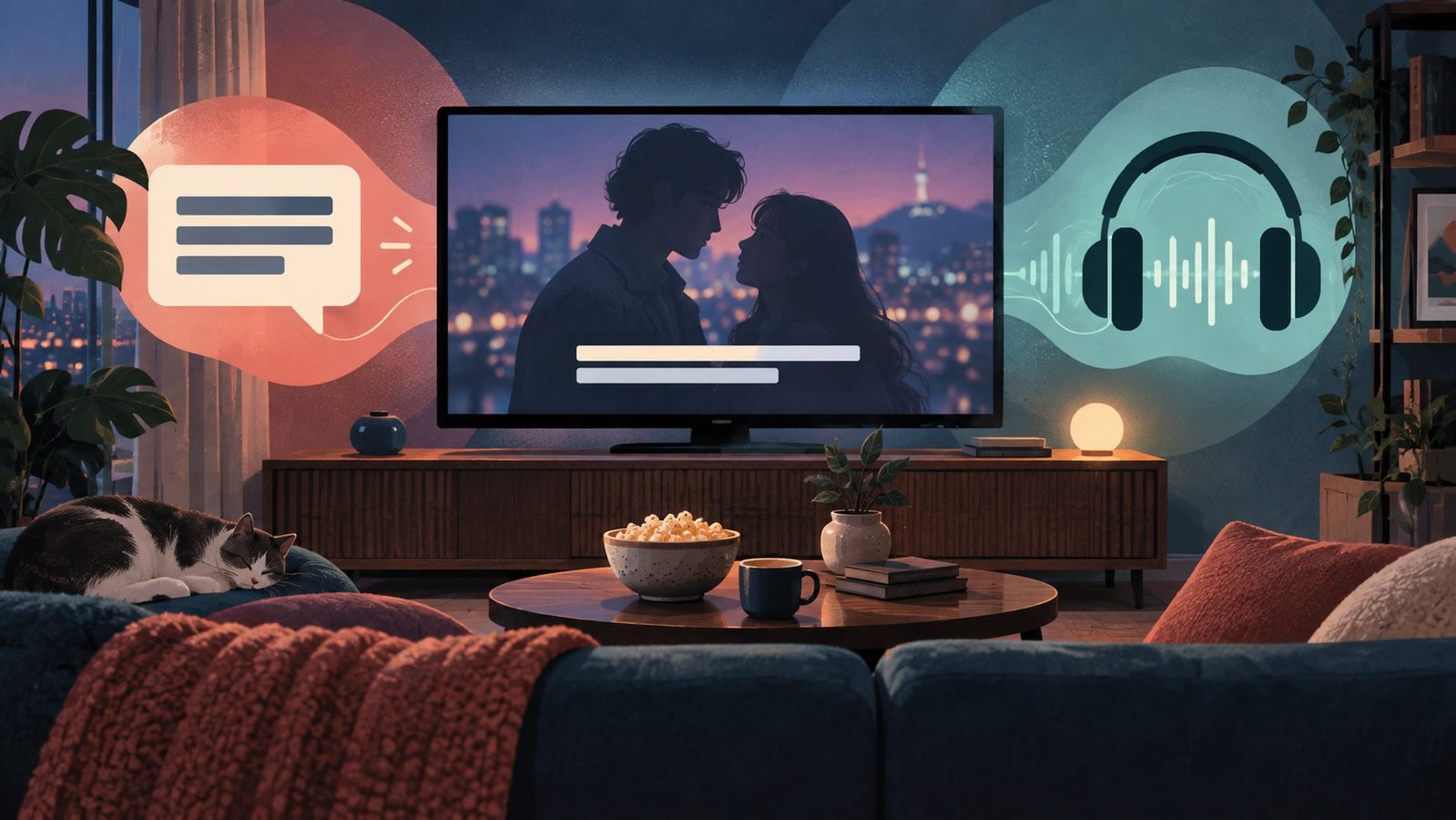
Should you watch a K-drama with the original Korean audio and English subtitles, or switch to an English dub? There is no single correct answer. The better choice depends on what you want to notice, how quickly you read, the device you are using, and whether accessibility features help you follow the story.
This guide explains the practical differences without treating one format as automatically superior. It also shows why the English words on screen may not exactly match the English dialogue you hear.
Quick answer
- Choose Korean audio with English subtitles when you want to hear the actors’ original voices, speech rhythm, and emotional delivery.
- Choose an English dub when reading pulls your eyes away from acting, action, costumes, or visual clues.
- Choose English SDH or closed captions when you also need speaker labels, music descriptions, or sound cues. Availability and naming vary by service and title.
- Try both for the same short scene if you are unsure. The version that lets you understand the story with less effort is usually the right one for that show.
What actually changes between the options?
| Option | What you keep | Possible trade-off | Best fit |
|---|---|---|---|
| Original Korean audio + English subtitles | Original voices, pauses, tone, and vocal performance | Your eyes may spend more time reading | Viewers who value performance nuance and read comfortably |
| English dub | More visual attention and easier hands-off viewing | Voice casting, timing, and phrasing differ from the original performance | Viewers who prefer listening or need to focus on the screen |
| English SDH/CC | Dialogue plus useful non-dialogue information | The text may follow the dub rather than another subtitle track | Viewers who benefit from sound cues, speaker labels, or dialogue transcription |
Why subtitles and dubbed dialogue may not match
A mismatch does not automatically mean that one version is wrong. Subtitles and dubbing solve different timing problems.
Subtitles must remain readable while a scene keeps moving. Netflix’s timed-text guidance says subtitles should synchronize with picture and audio and should not reveal punchlines or plot points too early. Long sentences may therefore be shortened or divided so viewers can read them naturally.
Dubbing has a different constraint: translated dialogue must fit the available speaking time and work with the character’s visible delivery. The result may express the same idea with different wording.
English SDH can create another surprise. Netflix’s English timed-text guide says that when a title is dubbed into English, English SDH should match the dubbed audio as closely as reading speed and timing allow. That is why an “English” subtitle track and an “English (CC)” or “English SDH” track can show different sentences during the same Korean scene.
Subtitles are best when the original performance matters most
Original audio preserves the actor’s own voice, breath, hesitation, volume, and rhythm. Those details can be especially important in scenes built around hierarchy, politeness, embarrassment, or restrained emotion.
Still, subtitles cannot carry every layer of spoken Korean. Honorifics, relationship terms, jokes, and culturally familiar expressions sometimes need to be condensed or adapted. Treat the subtitle as a carefully timed viewing aid, not a word-for-word transcript.
If you are comparing how a story feels in different forms, this is similar to the changes that happen between a comic and a screen adaptation. Our guide to what changes from webtoon to K-drama explains why performance, pacing, and structure can alter the experience even when the main story remains recognizable.
Dubbing is best when reading competes with the picture
K-dramas often communicate through small visual details: a character’s reaction after another person turns away, a message visible for only a moment, food placed on a table, or a change in posture during a tense conversation. If reading makes you miss those details, dubbing can improve your overall understanding.
Dubbed audio can also be the more comfortable option for viewers with reading fatigue, some visual impairments, or attention needs. It may help when watching on a small screen, although important episodes deserve full attention rather than background listening.
A dub is not automatically less faithful. It is a separate adaptation that balances meaning, timing, performance, and natural English. Judge it by whether the scene remains clear and emotionally convincing—not by whether every line matches another subtitle track.
How to tell subtitles, captions, and SDH apart
Labels differ among streaming services, but these distinctions are useful:
- English subtitles generally translate non-English dialogue for viewers who can hear the rest of the soundtrack.
- English SDH means subtitles for deaf and hard-of-hearing viewers. It may include speaker identification, music information, and relevant sound effects.
- Closed captions (CC) are captions the viewer can turn on or off. Some services use “CC” more broadly, so check what the selected track actually contains.
If a caption track seems different from the translated subtitle track, switch between the available English options during the same scene. One may be based on the original Korean dialogue, while another may be designed to accompany the English dub.
A five-minute test before choosing
- Select a spoiler-free scene near the beginning with both conversation and visible action.
- Watch two or three minutes with Korean audio and English subtitles.
- Replay the same section with the English dub. If available, test the regular English subtitle and English SDH/CC tracks separately.
- Ask which version helped you notice facial expressions, relationships, and story information with less effort.
- Keep that setting for the episode. Change later if the dialogue becomes faster or the visual storytelling becomes denser.
This test is more useful than arguing about a universal winner. A historical drama with unfamiliar titles may feel easier in one format, while a visually dense thriller may work better in another.
When a language option is missing
Netflix explains that available audio and subtitle languages can depend on your location, profile language preferences, the title, the device, and licensing agreements. Downloads may show only the two most relevant languages, and some older devices do not support every subtitle language.
Before assuming that a translation does not exist, try these checks:
- Open the title’s Audio & Subtitles menu while streaming rather than viewing a download.
- Check the language preferences for the active profile.
- Try a supported, updated device or web browser.
- Remember that a weekly series may add language options after an episode or season is completed.
Before paying for a service, verify the exact episode in its player. Our checklist explains how to check a K-drama’s English subtitles and dubbed audio before you subscribe, including regional, profile, device, and episode-level differences.
What if the drama came from a webtoon?
Translation is only one source of difference. A drama may combine characters, rearrange events, or create a new ending before any subtitle or dub is produced. If you want to trace the source without exposing yourself to major plot details, use our step-by-step guide to finding the original webtoon behind a K-drama without spoilers.
Bottom line
Use subtitles when hearing the original performance is your priority. Use dubbing when reading competes with the visual story or when listening is more accessible. Use SDH or captions when sound information and speaker identification improve comprehension. Switching formats is not cheating; it is a viewing choice.
The most reliable test is simple: compare the same short scene, then choose the version that helps you follow both the story and the screen.
Official references
- Netflix Help: How to use subtitles, captions, or choose audio language
- Netflix Help: Why subtitles or audio are not available in a specific language
- Netflix Partner Help: English (USA) Timed Text Style Guide
- Netflix Partner Help: Subtitle Timing Guidelines
This article was prepared with AI-assisted research and editorial review. Platform interfaces and language availability can change. We verify operational details against the linked official sources. For our editorial approach, see Content Principles. Questions or corrections may be sent through our Contact page.